Shao Fan
Refrain | 复沓
22 May – 27 June 2026
Dates
22 May – 27 June 2026
‘The classical Chinese worldview and philosophy of life are also near and dear to me. According to it, all things are equal and everything is one.’
Time without score
by Wenny Teo
The living is a passing traveller;
The dead, a man come home.
One brief journey betwixt heaven and earth,
Then, alas, we are the same old dust of ten thousand ages.
The rabbit in the moon pounds the medicine in vain (…)
Looking back, I sigh; looking before, I sigh again.
Li Bai 李白 (701–762 CE) ‘Twelve Poems Imitating the Ancients, No 9’《拟古十二首》1
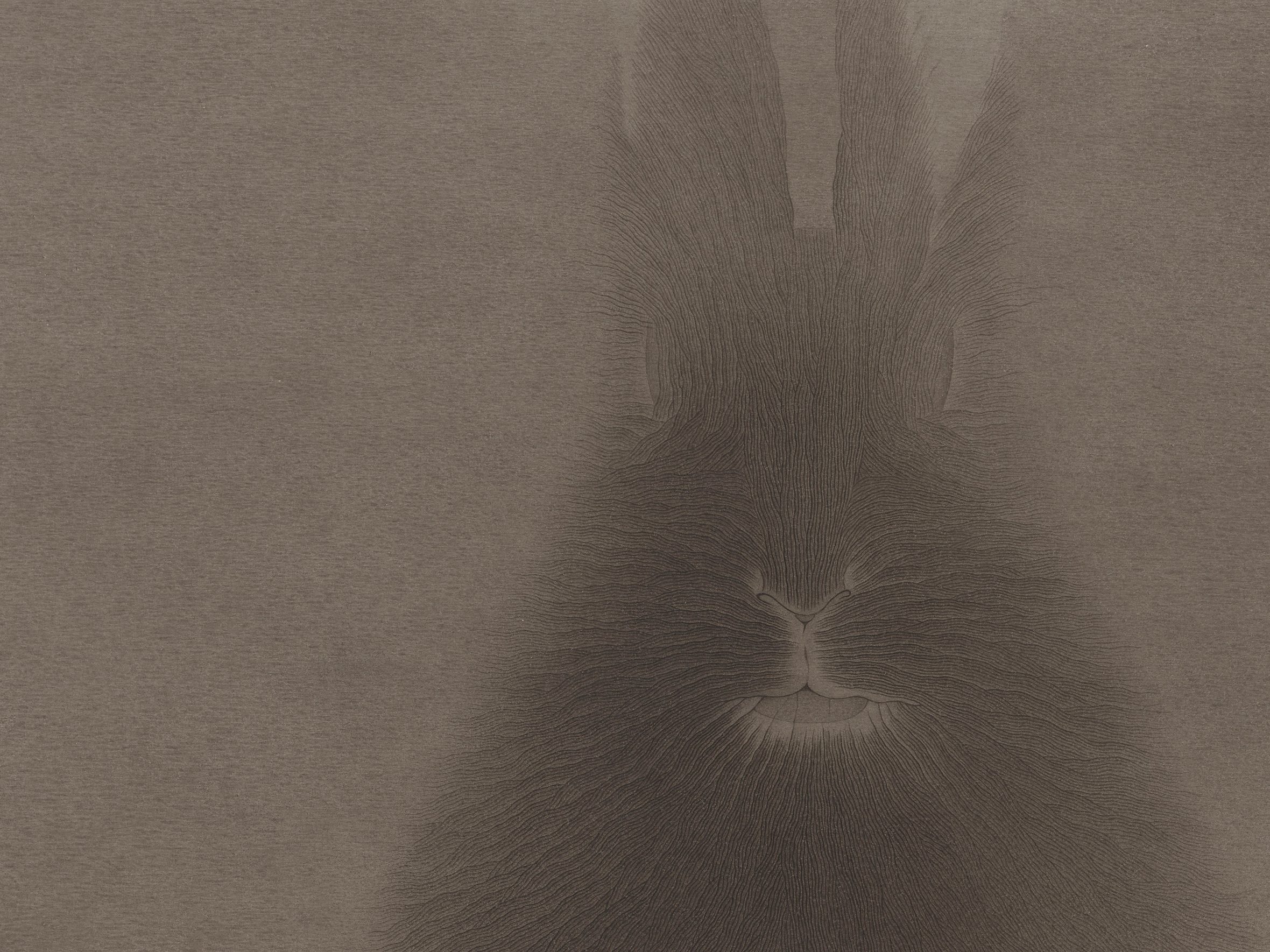
Shao Fan’s oeuvre is overrun with rabbits. They first appeared in his paintings around 2009 and have continued to resurface ever since: solemn, watchful and strange. Enlarged to near-human proportions, they face the viewer head-on, sitting upright with the ceremonial frontality of Chinese ancestral portraits. Soft ears raised, dark eyes almost at level with our own. In the earliest of these paintings, the rabbits were more figurative and detailed, fleshed out in muted hues of acrylic and oil. As Shao’s technique and palette grew more restrained over time, the rabbits have become more spectral and elusive, coaxed into tenuous form with hair-like strokes of black ink. Even when their eyes are no longer visible, as in his most recent series of paintings, we somehow still feel as if they are staring back at us through the void.
Shao often relates the story of looking into the eyes of one of the rabbits in his care and feeling, for a brief moment, the animal returning his gaze. In that instant of mutual regard, the positions of observer and observed, human and animal became fluid and undecidable. Shao’s encounter recalls one of the most evocative parables in Daoist philosophy, in which the sage Zhuangzi (c.369–286 BCE) describes a vivid dream of floating through the air as a butterfly, and upon awakening, wonders if he is but a butterfly still dreaming it is a person. What the parable suggests is consciousness attuned to another frequency of perception, where selfhood, species and time no longer hold their usual forms.2
This transformative experience opened a door to what might be considered a ‘creaturely turn’ in Shao’s aesthetic philosophy and practice. The rabbit portraits were soon followed by an eclectic bestiary, animal, vegetal and chimerical: old apes and cabbages, giant lingzhi mushrooms and sea creatures, bearded arhats and apples. The rabbit offers the clearest passage into the artist’s curious repertoire of quotidian and quixotic things. It is a creature of the threshold, moving above and below ground, associated with seasonal recurrence – the arrival of spring, the abundance of autumn, the waxing and waning of the moon. In East Asian mythologies, the cratered surface of the moon is said to resemble a jade rabbit, dutifully grinding the lunar dust into an elixir of immortality for the exiled moon goddess.
Shao’s iconography is cohered by the symbolic field longevity, wisdom and transformation share, each intimately connected to the passage of time. Yet Shao’s fixation with these temporal symbols could also be seen to reflect a deeper chronic anxiety which seems to be unique to our species. What does it mean to exist as a creature so painfully aware that time is fleeting? As the Romanian-French writer Emil Cioran once remarked, ‘There is something sacred in every being unaware [time] exists, in every form of life exempt from consciousness. He who has never envied the vegetable has missed the human drama.’3
In the small-scale painting Chinese Cabbage (2024), the most ordinary of household vegetables is imbued with the solemn gravity of a devotional object. Its crisp white stem cuts a luminous horizon across the pictorial field, while at its head, the crumpled folds of its leaves dissolve into the soft, grainy darkness around it. It is a work that does not lend itself to cursory viewing. At a glance, the image appears almost glitchy, as if obscured by a haze of televisual snow. Up close however, this apparent pixelation resolves into a tactile field of hand-painted brushstrokes, each an index of subtle variations in pressure, rhythm and touch. The longer we look, the more conscious we become of the sheer accumulation of labour sedimented in the surface, the more we marvel at the time it must have taken to complete. The humble cabbage becomes an image of temporal multiplicity: durational, gestural, material and imaginary, the artist’s time and ours enfolded into a single pictorial surface.
That surface is also a landscape, or at least it begins to look like one. The cabbage’s folds become mountain peaks, ridges, vapours and weather systems, ink marks gathering like storm clouds into areas of atmospheric density before dispersing into thin veils of pigment. The resemblance to Chinese landscape painting or shan shui 山水 is deliberate, not least because Shao executes his work on the traditional rice paper xuan 宣. For Shao, landscape is not simply a genre but a way of thinking through transformation: the ‘rhythmic vitality’ or qi 气 that flows through all things, animating apparently inert forms far older than any human life. As Shao notes, ‘In the case of ink painting, the picture is written with the brush […] We in China don’t paint a picture, we write it. Writing with the brush represents a form of turning oneself into air. Insofar as one expresses one’s inner feelings, one feels relieved; one frees oneself from the enormous burden of one’s own feelings.’4
By the Song dynasty (960–1279 CE), this understanding had generated a refined painterly vocabulary of ‘texture strokes’, or cunfa 皴法: dots, dabs, rubbed lines and striated washes used to evoke the granular materiality of eroded stone, weathered wood, wrinkled skin. Shao has expressed particular admiration for Li Tang 李唐 (c.1050–1130), who was celebrated for the ‘axe-cut’ stroke, fupi cun 斧劈皴. We can feel an echo of these incisive actions in Shao’s small, deliberate marks as he chips away at the negative space of his paintings: a human hand moving, however precisely, within a vastly larger order of things, scoring time into matter. The return to traditional forms and techniques lies at the core of Shao’s artistic philosophy, which he describes through the term shen lao 審老: an appreciation for oldness. Shen implies careful scrutiny, examination and close looking; lao carries associations of age, familiarity and warmth. It describes the affection we hold for elders, old friends, old haunts and time-worn things: those familiar presences that have withstood the test of time, a term of endearment as well as endurance.
This differs from another Chinese character, jiu 旧, which also means ‘old’ but often carries the more negative sense of obsolescence: things worn out, outmoded, deemed no longer fit for purpose. It was this sense of oldness that Mao Zedong mobilised at the start of the Cultural Revolution (1966–76), when the Red Guards were urged to destroy the ‘Four Olds’ si jiu 四旧: old customs, old habits, old culture and old ways of thinking. In the years that followed, temples and religious icons were desecrated; classical paintings, books and objects were destroyed. Shao was only two years old when the Cultural Revolution began, yet its afterlives shaped the generation that came of age during the ideological contradictions of the post-reform period. The optimism of the avant-garde ’85 Movement gave way to the bold and affronting idioms, later known as Political Pop and Cynical Realism, pioneered by some of Shao’s contemporaries. Their work caught the attention of a newly expanded global art world hungry for images of historical rupture, dissidence and spectacle.
Shao’s practice sits uneasily within these art historical genealogies, however. When asked to reflect on contemporaneity, Shao remarked: ‘The here-and-now exists at the most insubstantial level. The future and the past both lie in the same direction… I have sought to transcend time; and in doing so time has been negated and lost its meaning.’5 This may seem, at first, to echo Cioran’s bleak envy of forms of life exempt from temporal consciousness. Yet Shao’s transcendence is grounded in practice, attention and touch, a patient loosening of time from the narrow measure of the present. His return to antiquated styles and techniques is closer to the Daoist sense of fu 复: return, recurrence, reversal. Fu gu 复古, the return to old ways, is itself an ancient practice, one with deep roots in the literary and artistic tradition of Chinese antiquity. Yet Shao’s shen lao 審老, his ‘appreciation of oldness’, gives this return a more warm and intimate tenor. ‘Oldness’ is not approached as a remote historical ideal, but as something familiar, time-worn and still vital. In this, his work invites us to attune ourselves to multiple registers of time, from the flash of a rabbit’s eye to the slow accumulation of ink on paper, from vegetal growth and geological weathering to the aeons embedded in the moon’s cratered surface. Time moves here as a rhythmic flux of transformations through which matter, memory and consciousness remain, quietly and stubbornly, alive.
Biographies
Wenny Teo is Senior Lecturer in Modern and Contemporary Asian Art at The Courtauld Institute of Art, University of London. Her research examines transnational artistic practices across China and the Sinophone world, with particular attention to abstraction, infrastructure, migration, ecology and geopolitics. She convenes the Asymmetry Lecture Series at The Courtauld and serves on the editorial boards of Oxford Art Journal and the Journal of Contemporary Chinese Art.
Shao Fan was born in 1964 in Beijing, China, where he continues to live and work. Solo museum exhibitions include Het Noordbrabants Museum, Netherlands (2020); Ludwig Museum im Deutschherrenhaus, Koblenz, Germany and Suzhou Museum, China (both 2018). His work has appeared in numerous group exhibitions, including the 15th Shanghai Biennial, Power Station of Art, Shanghai, China (2025); M+, Hong Kong (2021); Kunstmuseum Luzern, Switzerland (2018); Deichtorhallen Hamburg, Germany (2014); Musée des Arts Décoratifs, Paris (2014); The Metropolitan Museum of Art, New York (2013); amongst others. In 2008, Shao Fan was the gold medal winner of the RHS Chelsea Flower Show in London for his design ‘I Dream I Seek my Garden’. His work is part of many museum collections, including The Metropolitan Museum of Art, New York; Victoria and Albert Museum, London; Fukuoka Art Museum, Japan; Centre Pompidou, Paris; National Art Museum of China, Beijing; and M+, Hong Kong.
1 Li Po, The Works of Li Po, the Chinese Poet. Trans. Shigeyoshi Obata (New York: Dutton & Co) 1928, p.101
2 Heinz-Norbert Jocks, ‘The Beautiful and the Old: A Conversation with Shao Fan’, 2014, Galerie Urs Meile (online)
3 Emil Cioran, The Fall into Time, Richard Howard trans. (New York: Quadrangle), p.178
4 Heinz-Norbert Jocks, Galerie Urs Meile, 2014
5 Heinz-Norbert Jocks, Galerie Urs Meile, 2014
Installation Views


Featured Works


Shao Fan
The Northern Sea 3, 2023


Shao Fan
In The Name of the Rabbit 1022, 2022


In the Studio
Shao Fan
‘The time I spent in the studio felt infinite. I could use it indefinitely. It was a bit like when drawing a rabbit, the second hair comes about from the relation with the first hair. Similarly to when you draw a long line, and then repeatedly layer line after line over it, it is a way of re-outlining.’ – Shao Fan
From his Beijing studio, Shao Fan reflects on the meditative process behind his meticulous monochromatic ink-on-rice-paper paintings.

Shao Fan
The practice of Beijing-based artist Shao Fan (also known as Yu Han) is informed by a deep engagement with traditional Chinese culture, whilst also referencing elements of Western art history. Mixing past with present, his ethereal paintings, sculptures and installations explore the interconnectedness of humanity and nature.
Visit Artist PageCreate an Account
To view available artworks and access prices.